

Introduction
The R-S flip-flop logic function is experimentally proved by conducting experiment 7 in our practical session.
AIM
To prove the logic function of the R-S flip-flop
Learning Objective
- To construct and study the characteristic and logic functions of R-S Flip-flop.
- To arrive at the Truth table with the results of the experiment to prove it.
R-S flip-Flop
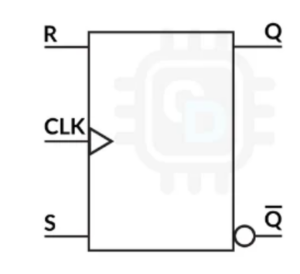
The R-S flip-flop has two inputs called S (Set) and R (Reset), and two outputs called Q and Q̅ (Q dash).
When the S input receives the correct logic signal , the flip-flop goes into the set state and stores binary 1, and the Q output becomes High.
Similarly when the R input receives the correct logic signal , the flip-flop goes into the reset state. and stores binary 0, and the Q output becomes Low.
As such, to get two different outputs, two inputs are required.
Materials required for the R-S Flip-Flop experiment
| S.No | Items | Quantity |
|---|---|---|
| 1 | IC 7400 Quad 2-input NAND Gate | 1 |
| 2 | 14 Pin DIP socket | 1 |
| 3 | Logic Level Indicators | 2 |
| 4 | DC volt meter (0-20v range) | 1 |
| 5 | SPDT switches | 2 |
| 6 | 5V Regulated Power Supply | 1 |
| 7 | Electronic Breadboard | 1 |
| 8 | Jumper wires | As required |
Procedure
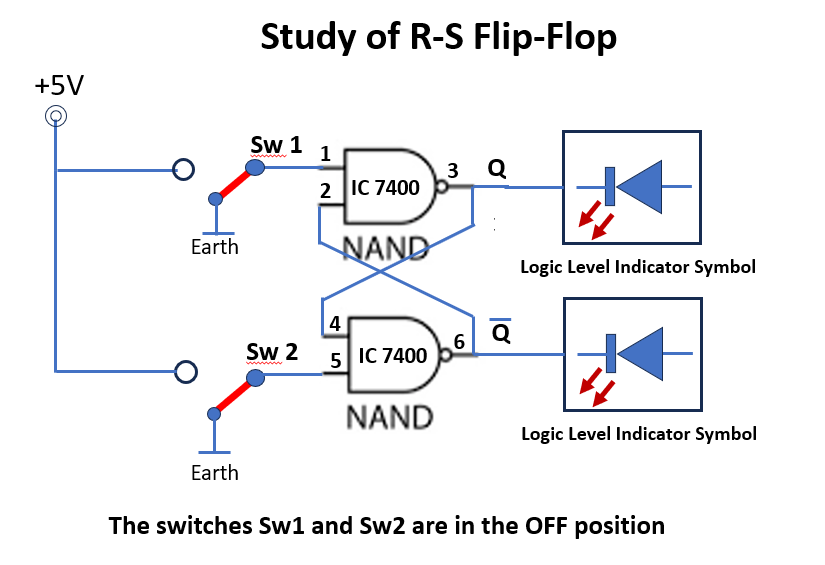
Now we will carryout step by step experiment making use of the two switches conditions and at the same time observe the Logic level indicator LED for the tests and record the same in a tabular column for our analysis. The circuit schematic of the R-S flip-flop using the Quad 2 input NAND gate IC 7400. However we make use of only 2 gates out of the 4 gates available in the IC package.
The circuit diagram and connection details of the Logic level indicators are already described in our earlier practical session. Please refer the same and do accordingly. Connect the circuit as shown in the figure. Connect Pin 14 of the IC to +5V power supply and Pin 7 to ground as they are common to the digital electronics circuit. It is customary not to show the connections in all the circuits and they are there.
Step-1 :
Put the two switches SW1 and SW2 in the OFF position. i.e. they are turned to Earth. Both the inputs are in the binary 0. Observe the output level, the value of Q and Q’ will be same as their previous value, i.e, Hold state.. Now observe the logic level indicator LED and record the observations.
Step 2:
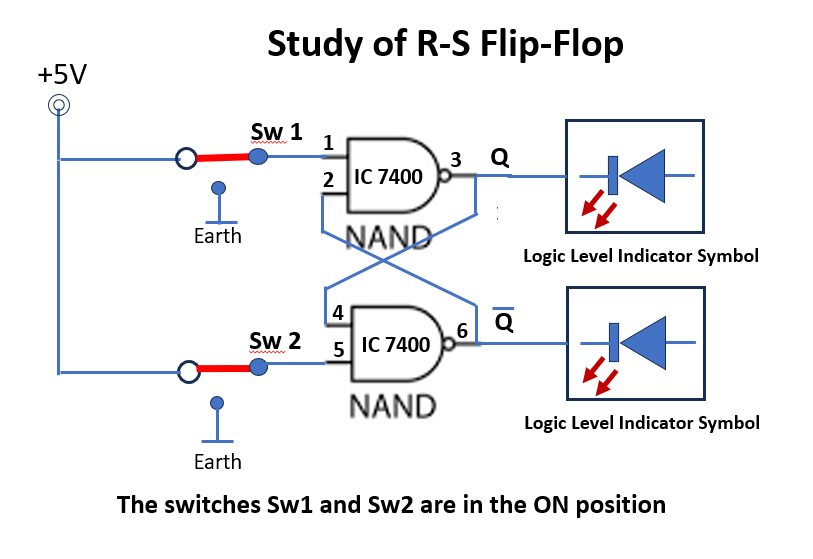
Put the both switches SW1 and SW2 to ON position. i.e. both the inputs are connected to +5V power supply. AS such both inputs are binary 1, then there is no change in the output level , i.e. the output stays in its previous state. . Observe logic level indicator and record.
Now, put the switches SW1 and SW2 to different positions and note the output levels as indicated by the logic level indicator LED.
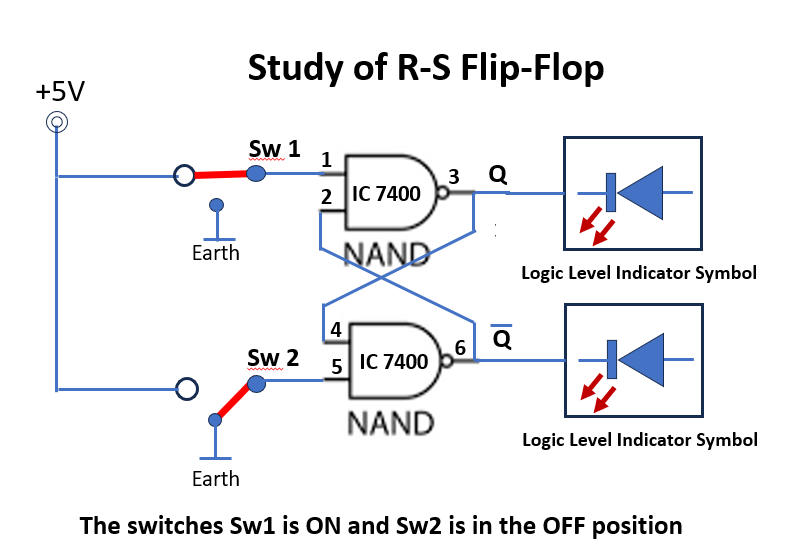
Step 3:
Put the switch SW1 to ON and Sw2 to OFF. When Set input gets binary 1 and Reset input get binary 0. Its output becomes binary 1, so Q will become 1. Observe Logic level indicator LED and record the observation.
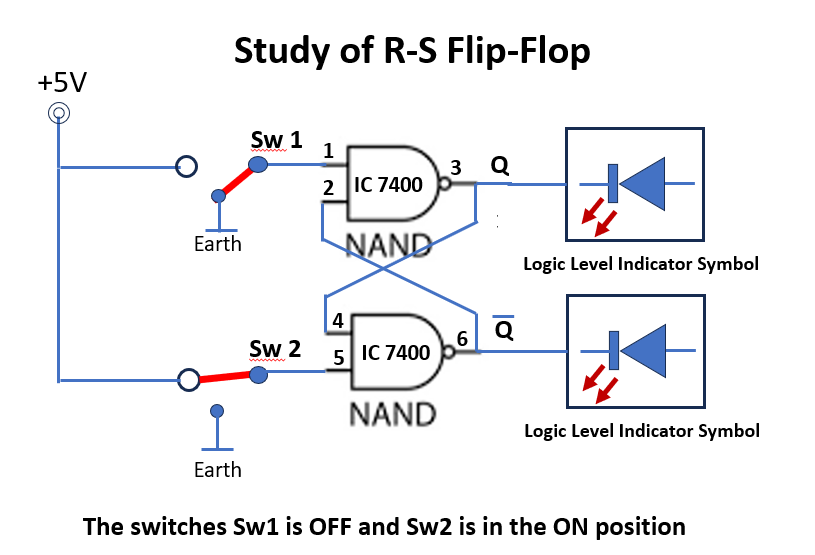
Step 4:
Put switch Sw1 to OFF position and switch Sw2 to ON position. Set gets binary 0 input and Reset gets binary 1. Its output becomes High. Q’ will be 1. Observe Logic level indicator LED and record the observation.
Toggle switch SW1 a number of times to see if there is any change in the Q output level. Tabulate the observations and make the truth table and analyse the results.
Logic level Indicator
Indicator 6 is used to test logic pulse
Indicators 1 to 5 are used to test logic level outputs whether it is high or low.
In the circuits to follow in our practical experiments, the full logic level circuit will not be shown and instead only a symbol as shown in fig. below will be used to indicate the full circuit comprising of one inverter, one resistor and one LED.
Logic Level Indicator circuit
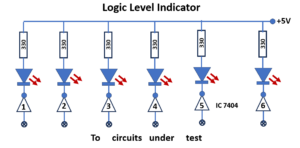
This will be helpful for connecting the indicator to the experimental circuit. As such wherever the logic level indicator is used in our digital circuit experiments, this circuit becomes handy to refer for connections. The indicator is always shown as symbol given above.
Results
- The R-S flip-flop is set i.e. its output becomes binary 1 when the S input is a binary 0 – LED not lighted.
- The R-S flip-flop is reset i.e. its output becomes binary 0 when its R input is binary 0- LED lighted.
- If both inputs are binary 1, there is no change in the output level , i.e. the output stays in its previous state-No change in the LED lighting.
- The flip-flop gets set (or reset) on the very first contact of the switch. Subsequent contacts have no effect on the final state – static LED.
Truth Table
From the foregoing discussion on the conclusion points, a truth table is arrived at to put the fact in nutshell.
| S Input | R Input | Q Output |
| 0 | 0 | 0 Invalid |
| 1 | 1 | Previous state |
| 1 | 0 | 0 |
| 0 | 1 | 1 |
Conclusion
The results obtained from the experiment are truly established the truth table for the logic functions of R-S flip-flop. From the working of the NAND gate latch, we can understand that the SET and RESET inputs are active LOW. This means they work when the input is 0.
When the SET input is 0 (LOW), it makes the output Q = 1.
When the RESET input is 0 (LOW), it makes the output Q = 0



[…] You may be interested in building a ‘7-segment display circuit’, then read this post. […]