


Introduction
“The NOT Gate” is the third basic decision-making logic element under logic gates. It is also called an “INVERTER”—a negation gate function in logic circuits, which is very important in building block in digital electronics circuits. Let us discuss this NOT operation, i.e., negation operation, in depth, so that you will get a thorough knowledge about this logic gate function. It is said that “inverter’ or ‘NOT Gate’ is the simplest form of logic circuits.
NOT Gate
Basic Operation of NOT Gate
|
Input |
Output |
|
High (1) |
Low (0) |
|
Low (0) |
High (1) |
A NOT gate has only one input and one output.
Because it reverses the input signal, it is called an inverter.
This is the main function of the NOT Gate.
Binary Inputs
| Input | Output |
| Binary 0 | Binary 1 |
| Binary 1 | Binary 0 |
As such, a binary 0 at the input gives a binary 1 at the output. In the same way, binary 1 at the input gives binary 0 at the output.
Hence, we can say that the inverter’s output is the ‘complement’ of the input.
Mathematically, it is represented as Q=A’ (A dash).
The gate does not create a new signal. It only reverses the existing one.
This inversion operation is useful in many digital circuits where opposite control signals are needed.
The ‘NOT gate’ is also called an “Inverter” because its output is exactly opposite to the input state. This is the main function of the NOT Gate. As such binary 0 at the input gives a binary 1 at the output. In the same way, binary 1 at the input gives binary 0 at the output.
We know that the simplest inverter in function can be obtained with a Transistor switching circuit. It is that simple and very widely used in most circuits for inverter operation. We will briefly discuss the transistor inverter switching circuit using a circuit diagram shown below.
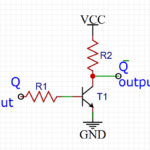
Almost every electronics person knows this transistor switching circuit, which gives the opposite signal at the output to the signal given to the input. Here Q signal gives an output signal, which is denoted as Q’. This is the single-transistor inverter circuit.
When an input of 5V is given to the input, the output becomes 0V. When the input is connected to the ground , the output shows 5V . Thus the inverter works and confirms that the output is always reciprocal to the input signal. This can be represented in a simple table format for clarity and ease of remembrance.
NOT gate voltage table
| Input | Output |
|---|---|
| A | A' |
| 0 V | +5V |
| +5V | 0V |
This table establishes the logic function of the ‘NOT gate’ for the binary inputs and binary outputs. The truth Table for the NOT Gate is shown below.
Truth Table for NOT Gate
| Input | Output |
|---|---|
| A | A' |
| 0 | 1 |
| 1 | 0 |
INVERTER Symbol

The bubble at the output tip represents inversion. A gets the binary input. A’ is the inverted output.
HEX INVERTER IC 7404
NOT gate is easily available in TTL Logic IC 7404
The 14-pin DIL IC package contains 6 inverters in a single package. See the picture below.
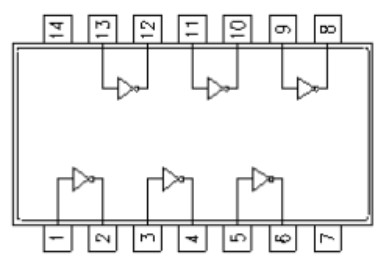
Pin 14 gets a positive power supply, whereas pin 7 is grounded. Pin 1 is the input to the first inverter and pin 2 is the output. Like that, 6 inverters are packed in this 14-pin DIL IC. The second inverter is Pin 3 and 4, Third inverter is Pin 5 and 6, and so on.
The analogy for the inverter gate is shown here. This circuit set-up explains how the inverter function takes place in each set of inverters in the HEX Inverter IC 7404.

The functional diagram of the 4 transistors with the configuration of resistor networks connected to the power supply works electronically and inverts the input A to the inverted output Y as shown in the picture. This is the inverter configuration of one set of inverter in the IC 7404.
The experimental set up was fully discussed in the theory post . Hence read more about it in the practical category.
Voltage Levels in NOT Gate
We know that Digital circuits work with voltage levels. As such, what are the voltage levels in the NOT Gate?
|
Logic state |
Voltage level |
|
Logic 0 |
Low |
|
Logic 1 |
High |
We have seen that the NOT gate simply converts ’Low to High’ and ‘ High to Low. ‘
Boolean Expression of NOT Gate
The Boolean expression of a NOT gate is: Y = A̅
Practical application in a real-life situation
Controlling the street light by the Inverter/NOT gate.
When the sensor output connected to the NOT gate is High during the daytime, the output becomes Low. As such, the street light is switched OFF.
During the night, the sensor output becomes Low. The output of the NOT gate goes high, and the street light is turned on.
This is the classic practical example of the functioning of the INVERTER gate in the real world.
Real-life example
The inversion operation of the NOT gate is very useful in digital circuits that require opposite signals as output.
Consider a light in a room is controlled by the NOT gate control system, then, to switch ON the light, Logic 1 should be the output. To switch OFFf the light, the output should be Logic 0. In other words, the device must remain OFF to keep the light ON. The light will go off when the device is kept ON.
Applications
- Alarm systems
- Switching circuits
- Logic circuits
- Timing circuits
- Computers
- Communication
Combinational gate
NOT gate as an important building block, combined with other gates to form different logic gates
Examples
- NOT+AND =NAND Gate
- NOT+OR =NOR Gate.
Advantages of NOT gate
- Design is simple as it has only one input and one output
- Quick operation
- Size is small
- Universally usable
- Low power consumption
Limitations are very minimal
Cannot take multiple signals as it has only one input. But this is overcome by combining gates with other types, like AND and OR.
INVERTER Gate highlights
- A NOT gate is also called an inverter.
- It has one input and one output.
- Output is always opposite to the input.
- Boolean expression: Y = A̅
- Used widely in digital electronics and computers.
Conclusion
Now you might be acquainted well with the NOT gate or INVERTER Gate logical function. It is an important logic gate widely used in digital electronics. You will study its characteristics and its binary function in the practical category under experiments. This practical will be very useful to ascertain the logical function of the Inverter gate without any doubt. Hope to meet at the experimental session in coming posts.




[…] it is the combination of an OR Gate and a NOT Gate. We have discussed the two gates ‘OR and NOT‘, in our earlier posts. Please note the key points regarding these two gates now, so that the […]
[…] The NOT Gate (INVERTER gate / Negation) […]
[…] commonly used logic gate ICs in digital electronics labs are:7408 IC – AND Gate7432 IC – OR Gate7404 IC – NOT Gate7400 IC – NAND Gate7402 IC – NOR Gate7486 IC – XOR GateThese ICs belong to the 7400 series, […]