


Introduction
The word sequential means something that happens in order, one after another. In ‘Sequential Logic Circuits’, the output does not depend only on the present input. It also depends on what happened before — the previous inputs and outputs.
The word “sequential” comes from the Latin word sequentia, which means succession or following in order.
A simple example of sequential operation is a table lamp with a push-button switch. When you press the switch, the lamp turns on. When you press the same switch again, the lamp turns off. The action (pressing the switch) is the same each time, but the result is different.
This example explains sequential logic clearly. If we consider the push-button switch as the input and the lamp as the output, pressing the switch can either turn the lamp ON or OFF. The result depends on the previous state of the lamp. So, the output depends not only on the present input but also on the past condition.
‘Sequential logic circuits’ are used in many applications like timing, controlling steps in order, and storing data. The most important feature of these circuits is memory. The output of a sequential circuit depends not only on the present inputs but also on the past inputs. This is because the circuit can remember previous information stored inside it.
Flip-Flops
The main parts used in these circuits are called flip-flops. Flip-flops store binary data (0 or 1). Their output changes according to the input signals and the data already stored in them.
‘Sequential logic circuits’ usually work with a repeating signal called a clock or trigger. The clock is an oscillator that produces regular rectangular pulses at a fixed speed (frequency). Most sequential circuits can work properly over a wide range of clock speeds. This is helpful because we can study how the circuit works by using a very slow clock, such as one pulse per second or even slower.
In practical use, the most common sequential circuits are counters and registers. Counters count the number of input pulses they receive. Shift registers store binary data (binary words) using a group of flip-flops.
The first sequential logic circuit we will learn about is the flip-flop. It is made using two NAND gates connected together.
A flip-flop is an electronic circuit that has two stable states. One state represents binary 1, and the other represents binary 0.
When a flip-flop is set to one state, it stays in that state as long as power is supplied, or until it is changed by an input signal. Because of this, it can store or remember data.
In digital circuits, flip-flops are used for storing information, counting numbers, controlling sequences, and timing operations.
There are four main types of flip-flops under sequential logic circuits: the Set-Reset (also called RS flip-flop or latch), the D type, the JK type and the T type.
4 types of Flip-flops
- SR Flip Flop
- JK Flip Flop
- D Flip Flop
- T Flip Flop
Each flip-flops work in their own way which is crucial for the logic function set up. Hence we should know each and every types of flip-flops, so that we may be able to design digital circuits according to the needs for fulfilling the required functions. We shall discuss each one in details in this post and coming posts. First we shall discuss the one simplest flip-flop namely the R-S flip-flop.
The S-R Flip-Flop
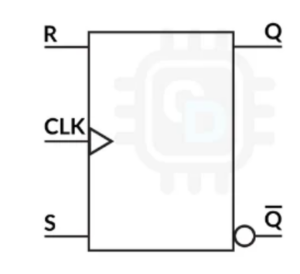
The RS flip-flop is the simplest one of the sequential logic circuit. It has two inputs called S (Set) and R (Reset), and two outputs called Q and Q̅ (Q bar).
If we apply the correct logic signal to the S input, the flip-flop goes into the set state. In this state, it stores binary 1, and the Q output becomes High.
If we apply the correct logic signal to the R input, the flip-flop goes into the reset state. In this state, it stores binary 0, and the Q output becomes Low.
As such, there are two inputs to get two different outputs.
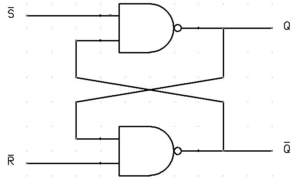
An S-R flip-flop can be made by connecting two NAND gates together so that the output of each gate is connected to the input of the other. This is called cross-coupling. The figure shows the circuit diagram, its symbol, and the truth table.
When both R and S inputs are 0, the outputs Q and Q̅ (Q dash) both become 1 (high). This situation is not allowed during normal operation because Q̅ should always be the opposite (complement) of Q. If both outputs are high at the same time, they are not opposite, so this condition is considered invalid.
Symbol of S-R Flip-Flop
Truth Table
The S-R Flip-Flop Truth table
| Inputs | Output | ||
|---|---|---|---|
| S | R | Q | Q' |
| 0 | 0 | 1 | 1 |
| 1 | 0 | 0 | 1 |
| 0 | 1 | 1 | 0 |
| 1 | 1 | No change | No change |
Similarly, an S-R flip-flop can be made by connecting two NOR gates together so that the output of each gate is connected to the input of the other.
From the working of the NAND gate latch, we can understand that the SET and RESET inputs are active LOW. This means they work when the input is 0.
When the SET input is 0 (LOW), it makes the output Q = 1.
When the RESET input is 0 (LOW), it makes the output Q = 0.
From the working of the NOR gate latch, we can understand that the SET and RESET inputs are active HIGH. This means they work when the input is 1.
When the SET input is 1 (HIGH), the output Q is 1.
When the RESET input is 1 (HIGH), the output Q is 0.
Conclusion
In this post, we discussed sequential logic circuits, including flip-flops and their types. To start with, we comprehensively covered the basic flip-flop, namely the S-R flip-flop. We also analysed its circuit setup, symbol, and truth table. We will continue our other types in our coming posts.




[…] ‘sequential logic circuits‘ post , then you can understand the basics of the flip-flops working differently in digital […]
[…] next tutorial on the sequential circuit is an in-depth discussion on JK Flip-Flops. We have widely discussed earlier two flip-flops, namely […]
[…] R-S flip-flop logic function is experimentally proved by conducting experiment 7 in our practical […]