


Experiment 2
AIM: To prove the OR Gate Logic function
Objectives:
There are two objectives in this experiment:
The objectives of this experiment are two-fold.
- To study the characteristics of the OR Gate
- To prove the operation of the OR logic function
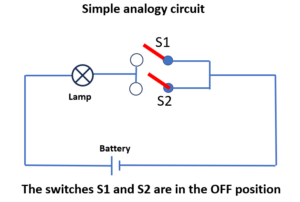
The functional characteristics of the OR gate can be easily studied with the help of the mechanical analogy. The mechanical analogy here is nothing but a simple electrical circuit, as shown below. We have already studied the theory of the characteristics of the OR gate in our earlier post. Please refer the theory post here to recognize the characteristics along with this experiment. To make it clear the characteristics of the OR gate is summarised as follows:
“The OR gate can have two or more inputs and a single output. Its operation is such that the output is binary 1 if any one or all inputs are binary 1.”
That shows clearly that for the positive output, we require that any one input should be binary 1. Read full text about the OR gate logic function in this post.
The electrical circuit
Quad 2-Input OR Gates: The IC 7432
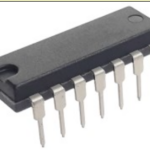
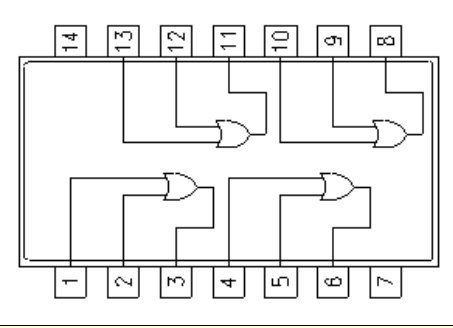
The electronic circuit for experimenting with the OR Gate logic function is designed using the Quad 2-Input OR Gates IC 7432. It is a 14-pin DIL IC that contains four OR Gates. It works on a 5V power supply. A positive power supply is given to pin 14 shown as VCC in the figure. Pin 7 is grounded and connected to the -ve power supply. The 7432 chip contains four independent OR gates, each capable of handling two inputs. This allows multiple operations to be performed simultaneously, which is efficient for complex logic circuits.
The IC 7432 operates under standard TTL (Transistor-Transistor Logic) power levels, usually around 5V. Wherever simple binary logical operations are required, this IC is used for educational purposes and practical applications effectively. The OR gate is well explained in the theory post. Please visit first and then come to this post for a better understanding of the OR gate logic functions.
Circuit schematic for the experiment
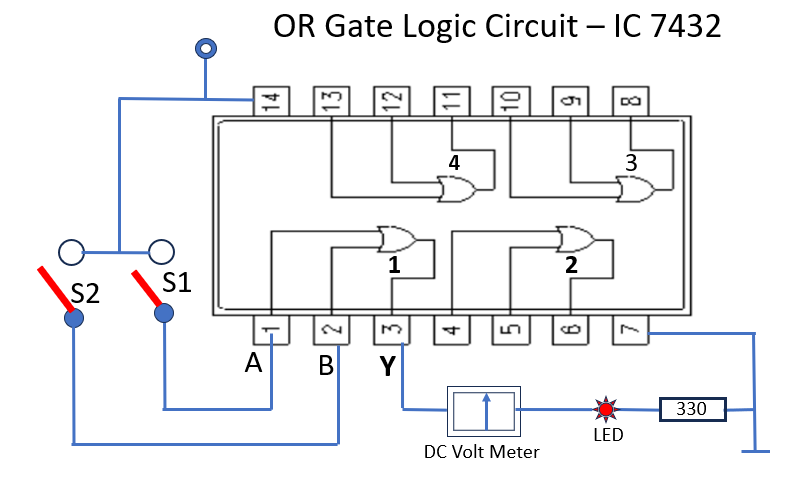
For our practical experiment purpose only one gate is used in the quad IC 7432. Our experimental circuit schematic is shown in the figure. This is to prove OR Gate logic function.
Gate number 1 is used in the circuit. Pin 14 gets a +5V power supply. Pin 7 is grounded.
Pin 1 gets the (A) input (power) from the Switch S1, which is connected to PS. Pin 2 gets the (B) input from switch S2, which is connected to PS.
Pin 3 is the (Y) output for the gate. The output is connected to a DC Voltmeter to measure voltage and a red colour LED through a limiting resistor to ground.
Materials required
To experiment to fulfil the objectives, say ‘the OR gate logic function’, the following items are required in the testing lab. The items are easily available and offered at a low cost. Most of the items can be reused in our subsequent experiments to be described later in our upcoming practical posts.
A list of items is shown in the table, along with the quantity required.
| S.No | Items | Quantity |
| 1 | IC 7432 Quad 2-input OR Gate | 1 |
| 2 | LED Red | 1 |
| 3 | 330 Ohm resistor | 1 |
| 4 | DC volt meter (0-20v range) | 1 |
| 5 | ON/OFF switch | 2 |
| 6 | 5V Regulated Power Supply | 1 |
| 7 | Electronic Breadboard | 1 |
| 8 | Jumper wires | Few Nos. |
Assembling the circuit
The required components go very well in the electronic breadboard. As such, on the electronic breadboard, all the components are inserted properly and assembled following the circuit schematic given. Appropriate wire connections are made with the help of the jumper wires. Only the power supply is not shown in the schematic, as it is kept outside the breadboard. Except for the PS unit, all other components are inserted in the breadboard and appropriate connections are ensured.
Our logic board is nothing but an electronic breadboard. No soldering is required and the same components can be used again and again for subsequent experiments without damage. It is cost-effective and easy to assemble, even for a novice. Any wrongdoing can be corrected without any difficulty. This is to study OR Gate logic function.
Procedure
- Connect the circuit as shown in the schematic.
- Connect pin 14 of the IC to +5V and pin 7 to the Ground, i.e., negative power supply through jumper wires.
- Let both switches, S1 and S2, be put in the OFF position initially.
- Now, put switch S1 to the ON position. Now measure the output voltage in the DC voltmeter and record it. Observe the condition of the Red LED and record it.
- Then turn the switch S1 to the OFF position, and switch on the switch S2 to ON position. Now measure the output voltage and observe the red LED and record the voltage and LED status.
- Now switch ON both switches S1 and S2 to the ON position. Measure the output voltage and observe the status of the Red LED. Record both findings.
- Neatly tabulate your findings /results as shown in the picture below and make a truth table as shown in the Figure .
Result of the Experiment
| S1 | S2 | Voltmeter reading | LED status |
| OFF | OFF | 0 V | Extinguished |
| ON | OFF | +5 V | Lighted |
| OFF | ON | +5 V | Lighted |
| ON | ON | +5V | Lighted |
The above table shows the result of the experiment, proving that the OR gate logic functions hold true. As such, the objectives of the OR gate are fulfilled: “The OR gate can have two or more inputs and a single output. Its operation is such that the output is binary 1 if any one or all inputs are binary 1.”
Now we can confidently create the truth table for the OR gate logical function as shown below. Simply understand digital signals.
The Truth Table
| A | B | Y |
| 0 | 0 | 0 |
| 1 | 0 | 1 |
| 0 | 1 | 1 |
| 1 | 1 | 1 |
Conclusion
We did the practical of conducting this very simple experiment to prove the objectives of the OR gate logic function using a very few components easily in a lab or even at home to explain the concept to the needy. I hope the students and others would have gained the practical knowledge of doing an experiment to prove an objective. By this experiment, we are able to arrive at the exact truth table for the OR gate logical function. We shall continue other experiments in this category in our coming posts as we progress our tutorial. Your valued comments are welcome.