


Introduction
The OR Gate

Now it is time to move on to the next logic gate, namely the “OR” gate. The OR gate is the second important gate function under basic logic gates. In this post, we will study the OR gate and its logic functions in detail. So do not miss the post to read till the end.
We are now thoroughly familiar with the AND gate and its logic function. Having acquired the correct knowledge regarding AND Logic gate, we will aim to acquire similar skills in the OR Gate also.
The OR gate and its operation can also be demonstrated in the mechanical analogy with two mechanical switches and a lamp. The logic function is best explained in this way for simplicity and clarity. We will explore this shortly after knowing what an OR gate is.
The OR gate is extensively used in Calculators, Computers, and automation systems. Many electronic devices also use the OR gate for superb functions. As such, in digital electronics, the OR gate becomes one of the most important logic gates. Since the working principle of the OR gate is very simple, even a novice can understand how it functions.
Simply, if any one input of the OR gate is’ON’, then the output becomes ‘ON’.
What is an OR Gate?
If one or more inputs are 1, then the output is 1
Whereas when all inputs are 0, then the output is 0
Any input is HIGH=Output is HIGH
All inputs are LOW=Output is LOW
OR gate symbol

Both the inputs A and B are connected on the left side.
The output is taken from the right side, shown as Y.
The symbol for the OR Gate is shown above. A and B are the two inputs. Y is the output. As discussed earlier, binary signals are given to the inputs A and B. It can be binary o or binary 1. When you give binary 0 to both the input, the output is also 0. When binary 1 is given to at least one of the inputs, then the output is also 1.
Thus, the OR gate logic function is established as follows.
‘The output is binary 1, if any one or all inputs are binary 1.
The working principle of an OR Gate
Inputs are given to the input points A and B of the OR Gate. Both gates check the inputs and give the output at Y as follows:
If at least one input is 1, then the output at Y becomes 1
If all inputs are 0, then the output at Y becomes 0
As such, the output depends upon the input conditions.
This input technique can be demonstrated using an electrical circuit as an analogy circuit.
Electrical Switch Analogy of OR Gate
Like the AND gate, the OR gate can have two or more inputs and a single output. Its operation is such that the output is binary 1 if any one or all inputs are binary 1.
The circuit schematic is almost similar to AND gate circuit schematic, except the switches are connected in parallel instead of a series connection. Observe the circuit schematic as a electrical switch analogy shown below:
Case 1
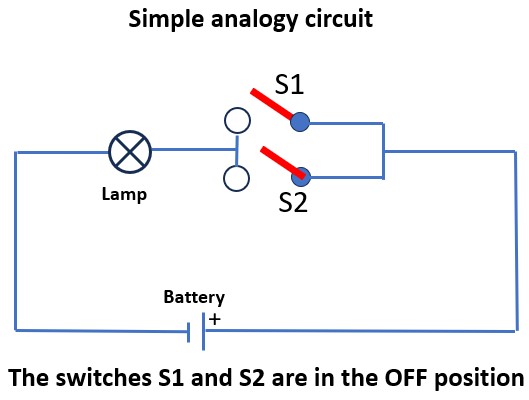
Switch S1 and S2 are in the open status.
When the two switches are in an open condition (OFF position), the lamp is extinguished. As there is no flow of current to the lamp. . The switches kept the open circuit condition.
Case 2
Observe the second picture:
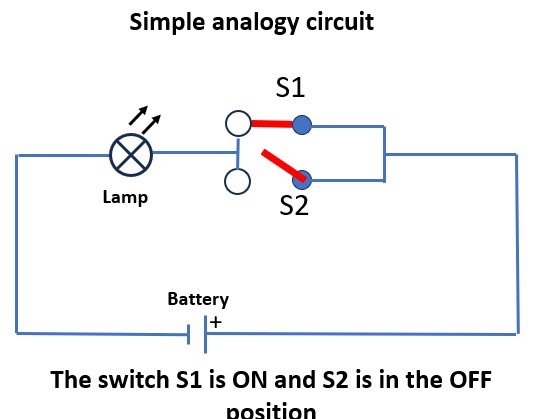
When Switch S1 is closed i.e.. Switched to ON position. Switch S2 is in the OFF position. The lamp is ligh
Case 3
In the third condition, see the picture:
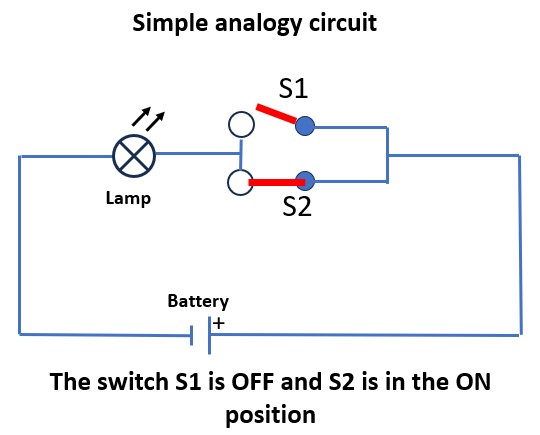
Now the switch S1 is put into the OFF position and S2 is switched ON. Now also the lamp is lighted. See the last condition:
Case 4
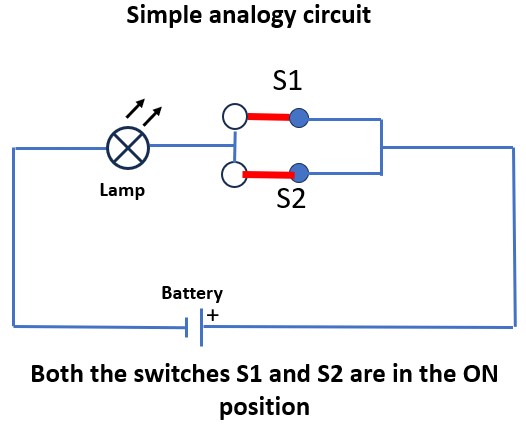
When both switches are kept in the ON position, the lamp is lit.
What these connections mean to us. Let us tabulate the operation of switches and analyse it.
The table shows below the true picture of the switch conditions and the status of the lamp.
| S1 | S2 | Lamp |
|---|---|---|
| Open | Open | Extinguished |
| Closed | Open | Lighted |
| Open | Closed | Lighted |
| Closed | Closed | Lighted |
When this OR gate circuit is connected to 5V power supply and applying the above table we can arrive at the following voltage condition table. This is a crucial step to achieve the truth table based on these findings.
| Inputs | Output | |
|---|---|---|
| A | B | Y |
| 0 V | 0 V | 0 V |
| 5 V | 0 V | 5 V |
| 0 V | 5 V | 5 V |
| 5 V | 5 V | 5 V |
OR Gate Truth Table
| INPUTS | OUTPUT | |
|---|---|---|
| A | B | Y |
| 0 | 0 | 0 |
| 1 | 0 | 1 |
| 0 | 1 | 1 |
| 1 | 1 | 1 |
Explanation of Truth Table
Case 1: A = 0, B = 0
Both inputs are LOW.
So the output is LOW.
Case 2: A = 0, B = 1
One input is HIGH.
So the output becomes HIGH.
Case 3: A = 1, B = 0
One input is HIGH.
So the output becomes HIGH.
Case 4: A = 1, B = 1
Both inputs are HIGH.
The output remains HIGH.
Thus OR Gate truth table establishes the functions of the gate as demonstrated by the electrical analogy circuit.
Boolean expression
2-input OR gate -Boolean expression is stated as follows:
Y=A+B
Decisively, if input A or B is 1, then automatically Y=1
Decisively If both the inputs A and B are 0, then Y=0
IC 7432
IC 7432 is an illustrative IC for the OR gate logic function. It is a Quad 2-input OR gate. It has four independent OR gates in a single package. As usual the pin 14 and pin 7 are devoted to the power supply connection. Pin 14 gets the positive power supply and pin 7 is grounded. Wherever OR gate logic function is required, IC 7432 Quad 2-input OR gate is used.
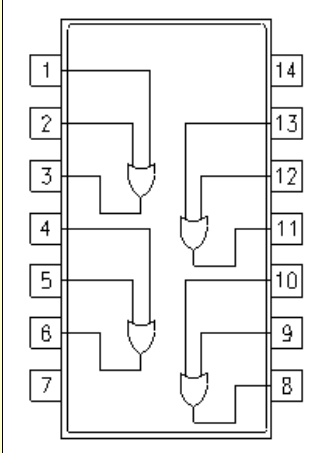
Real-life example of OR Gate
Consider a ceiling Fan in a room that is connected with two switches, one near the bed and another at a normal wall position. Both switches in combination behave like an OR Gate.
The four conditions of the switches:
| Switch 1 | Switch 2 | FAN |
| ON | OFF | ON |
| OFF | ON | ON |
| ON | ON | ON |
| OFF | OFF | OFF |
Both switches in the combination behaves just like OR Gate and hence the resultant output from the FAN connected to it.
Conclusion
Like the AND gate, we have discussed the logic function of the second basic logic gate element, i.e. the OR Gate, at length with an analogy of a mechanical circuit. We understand clearly the logic symbol for the OR Gate and the Truth Table. We shall prove the logic functions of this OR gate elaborately in our practical session. So, please do not miss that tutorial to gain more practical knowledge in this digital electronics study. We shall continue our tutorial with yet another logic gate in our next post.




[…] for the positive output, we require that any one input should be binary 1. Read full text about the OR gate logic function in this […]
[…] gate, it is the combination of an OR Gate and a NOT Gate. We have discussed the two gates ‘OR and NOT‘, in our earlier posts. Please note the key points regarding these two gates now, so […]
[…] You can exclusively distinguish between the OR gate and the XOR gate by reading the tutorial on the OR Gate. […]
[…] The OR Gate and […]