

Introduction
At the outset, in this post we intend to discuss in details the “Advantages of Digital Signals“.
The next day morning both youths Raju and Gopu were present sharp 10 am as committed by them yesterday. Wisely they brought a long size notebook and pens for taking down notes if necessary. I appreciated their interest in pursuing the lessons as it seems they are committed to learn the basics first on digital techniques and to follow the lectures in their institutions. Without any delay I immediately started my tutorial session with the first topic on digital electronics, namely ‘electronic signals’.
Electronic Signals
In this post we are going to discuss: What are electronic signals? Its characteristics and features with illustrations. Though you may be aware some of the points discussed it is advisable to follow my way of teaching the subject which will clarify a few hard core points on this subject matter.
Topics to be covered:
- Introduction
- Types of signals
- Advantages of Digital signals over Analog Signals
- Applications
- conclusion
What are electronic signals
In an electronic system, data or information have to be conveyed or transmitted from one point to another or from one place to another for which electronic signals are used. Electronic signals are nothing but time-varying quantities of signals such as electric current, voltage or even electromagnetic waves. Electronic signals are basic ways of transmitting information or data in all electronic devices. it is also adopted in our communication systems. These devices may be simple circuits to complex networks like control systems to computers.
I hope I have simplified the basics of electronics signals to understand even by the beginners in this field of digital electronics.
Having studied electronics signals basics, we will come to know how many types of electronics signals are available and what they are. As a second step we dive into its types directly.
Raju immediately jumped and said that there are two types of signals -Analog and Digital.
I said, “Well said Raju. You have good remembrance of your lessons taught in your institutions. Keep it up”.
Types of Electronic Signals
Broadly speaking, the electronic signals are classified into TWO main types, namely:
- ANALOG SIGNALS
- DIGITAL SIGNALS
Let us understand what they mean to us to know about electronic signals. By going through each type, one by one with illustrations, we will understand its nature, characteristics and advantages. From the analysis we can clearly establish the “advantages of digital signal. ‘
Now first we take up Analog signals for deep study.
Gopu asked “do you mean to say that at first deep study of Analog signal is necessary?
I replied,” yes, you will come to understand the difference between Analog and Digital signals only when you deeply study Analog signals first”. Then I started explaining Analog signals.
Analog Signals
Analog signals are said to be continuous signals which vary smoothly over time. Actually the waveform changes continuously as time passes on. Within a given range, they can show any value. Typically we can observe a smooth and continuous curve. They represent physical quantities such as light, sound or temperature or pressure etc.
The intensity of light varies from dim to brightness, Low sound to high sound , minimum temperature to maximum temperature and low pressure to high pressure in all with smooth and continuous variation. Let us explore more with our illustrations that will give you fantastic ideas about analog signals.
As such Analog signals are continuous one that changes smoothly, rather gradually. We can call it as ‘docile’ signals. Not subjected to sudden or furious changes like stormy weather.
Before discussing its characteristics and other features, let us now take up ‘Digital Signals’ simultaneously to distinguish it for more clarity and understanding. This will help you to judge correctly which one is analog and which one is digital.
Digital Signals
Gopu, asked, ” Do you mean to say that digital signals are furious ones?” thinking of the contrast to the analog signals nature. I said, “Let us discuss the full characteristics of the digital signals here, then you will understand the ‘Advantages of digital signals’ clearly.”
Digital signals on the other hand are vigorous, stormy and furious. In whatever way you call it it is lightning in nature.
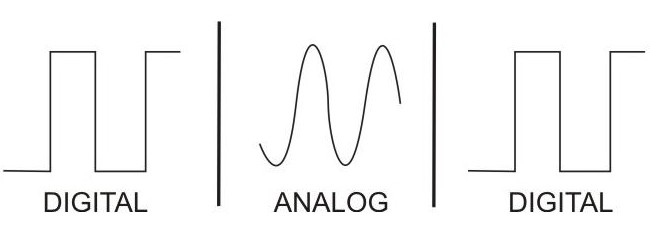
Digital signals are said to be discrete waveform signals that represent only two possible values as Binary Values (0s and 1s).
Don’t worry, we will explain what Binary value is in the coming posts. The binary values are the basics of digital electronics which are heart of the digital electronics.
In contrast to analog signals, digital signals are not continuous. They change with specific steps. Digital signals represent just TWO levels – On or Off, High or Low, Yes or No, Ok or No ok apart from 0 or 1.
Hence two states ‘either/or’ are denoted by digital signals. As I said earlier digital signals rule the digital world. Digital signals are used in most sought digital systems like Computers and digital communication devices such as Smartphones, Remote controls, digital clocks, timers etc.
You have to observe here in digital electronics that change occurs in steps and not continuously or smoothly.
Signal Characteristics
Having discussed the basic definitions and meaning of the ‘electronic signals’, let us now put the characteristics of each signal in a nutshell, so that the same will be clear and appealing to the readers.
Analog signals:
- Continuous in both time and amplitude
- Values are very wide i.e. can have infinite number of values within a range
- Can exhibit infinite number of possible values during the course
- Can represent true world phenomena like sound, light, temperature etc.
- Susceptible to noise
- Susceptible to distortion
- Degrades over long distances
- Commonly used in audio and radio signals
Gopu here interrupted and asked, “Can you give examples for Analog signals?”
“ Why not? Let us discuss some examples here with the help of charts” I said.
Examples:
A simple sine wave of an analog signal ( see picture)
The voltage from a microphone or an old-fashioned vinyl record player (Gramophone records). The signal varies continuously with the sound waves.
A sound wave, like a person’s voice, which varies continuously in frequency and amplitude.
The output from a microphone, which converts sound waves (a continuous physical quantity) into a continuous electrical signal.
Illustration: ( see picture)
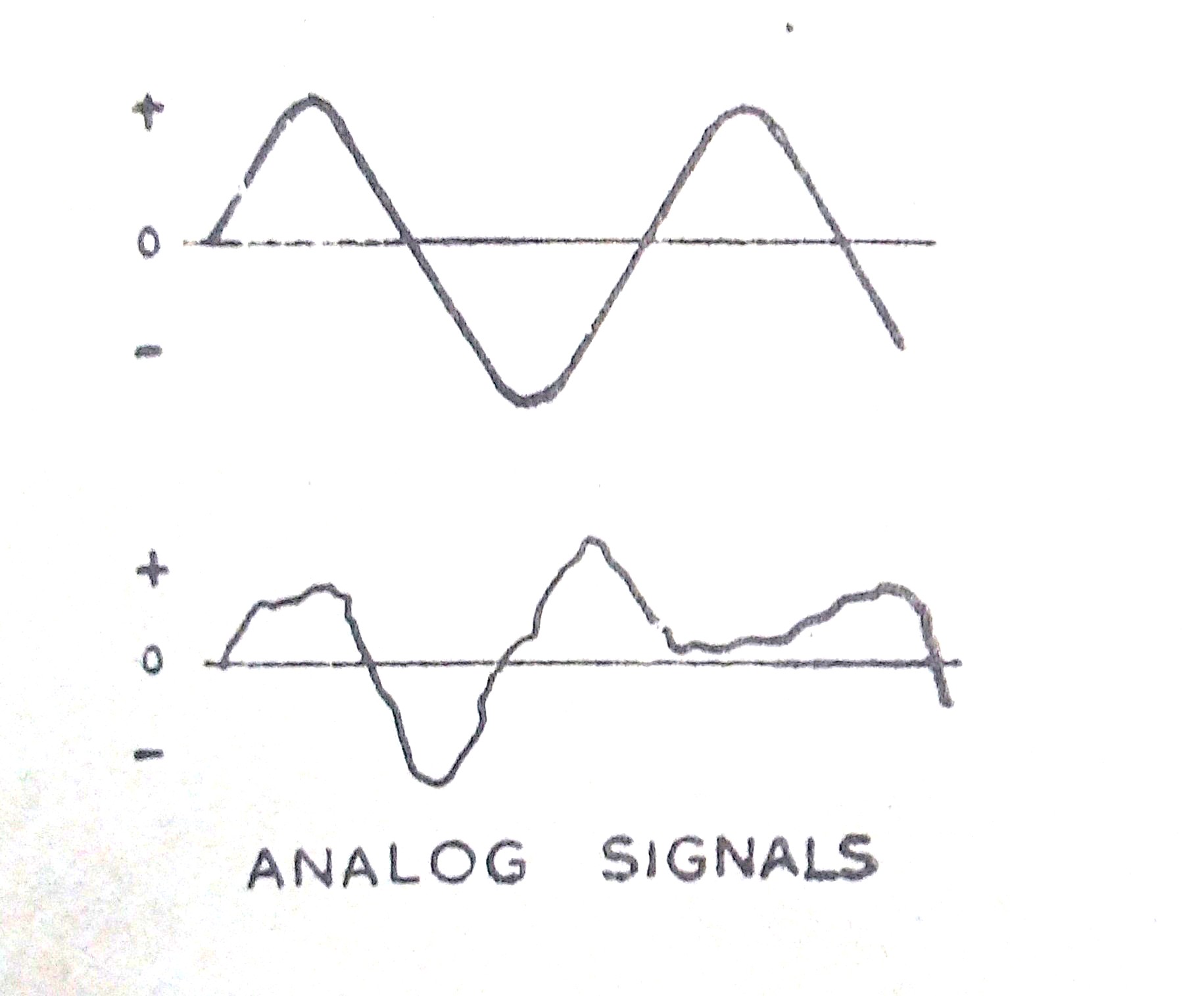
Analog signal wave form – observe how the wave form continuously varying over the time period.
Digital signals:
Now, we are ready to discuss digital signals here as they are pertinent to our study of digital techniques.
- Discrete in both time and amplitude
- Represented by binary values (0 and 1)
- Only specific values represented as High (1) and Low (0)
- More resistant to Noise
- Less susceptible to distortion
- Less susceptible to degradation
- Easier to store and process in digital systems
- Commonly used in computers and digital communication
- Ideal for long distance communication
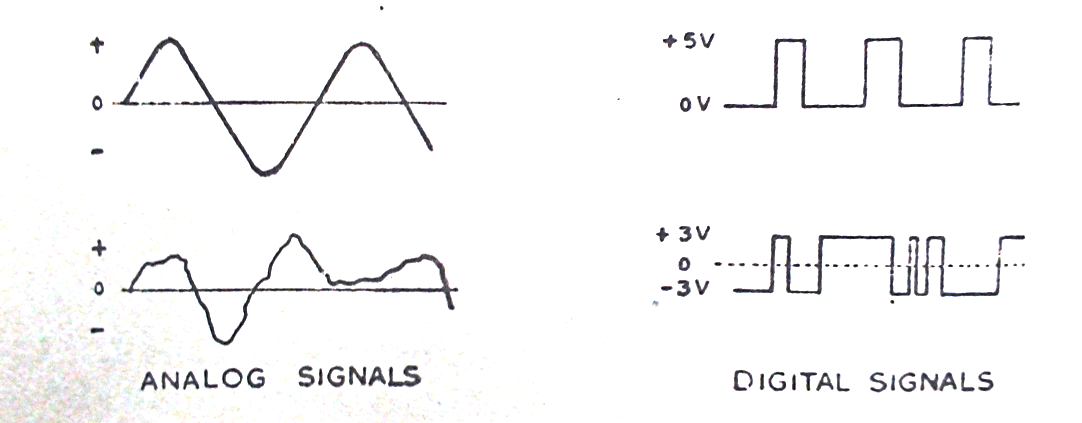
illustration (see picture)
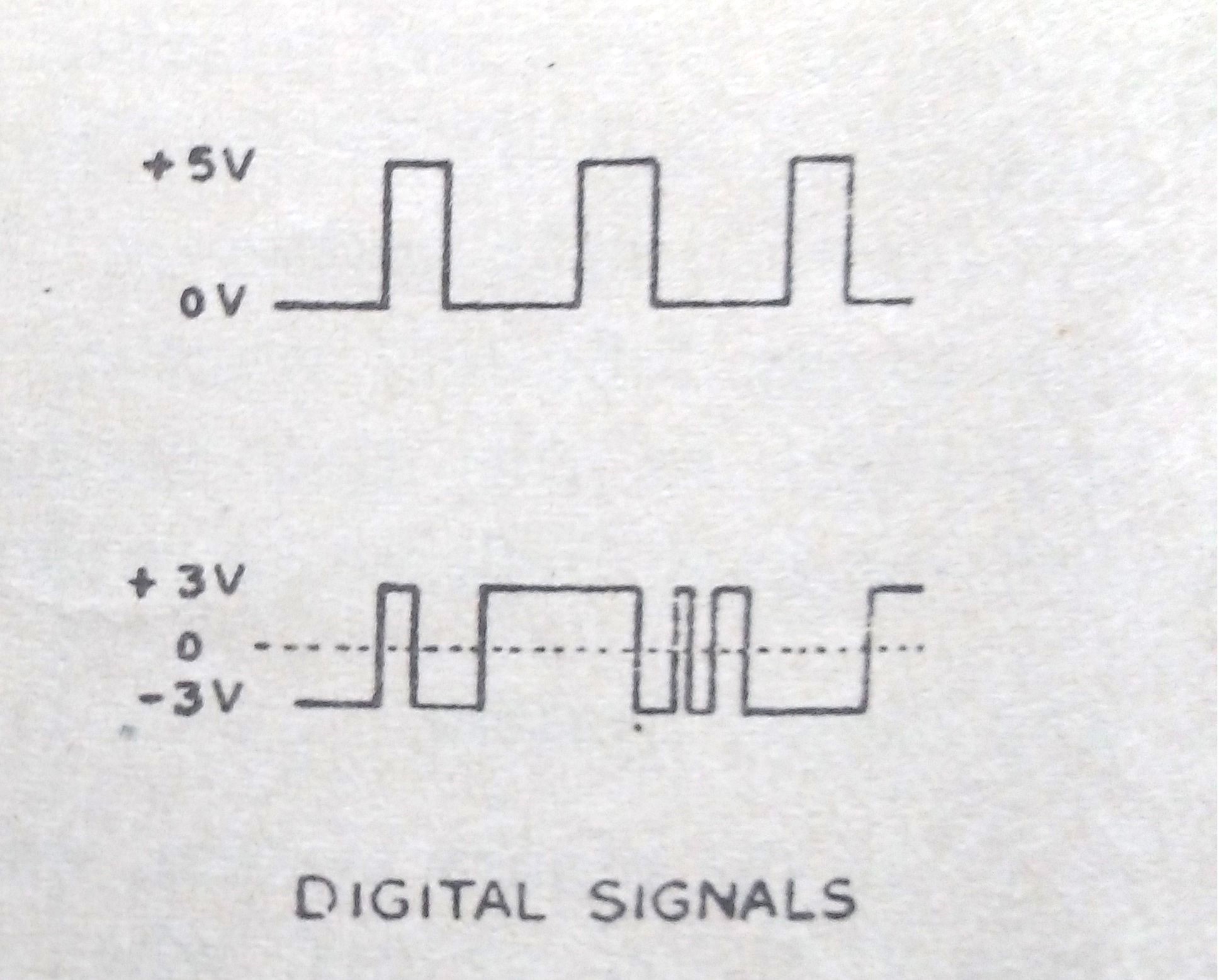
Observe how the digital signals vary in steps. one time it is ‘high’ next time it goes ‘low’. The wave form varies in steps. and not continuous.
Now let us discuss the key differences between analog and digital signals topic wise.
Representation:
Analog signals represent data in a continuous form. Digital signals do it in discrete form.
Noise:
Analog signals are more prone to noise. Digital signals are robust and their signals can be transmitted with minimal degradation because they have distinct levels 0 and 1.
Distortion:
Analog signal quality may be compromised with distortion. Digitals signals are mostly free from distortion.
Storage and transmission:
Analog signals lose quality over time whereas digital signals can be stored and transmitted without much loss in quality.
Complexity:
Analog systems are simple and less versatile. Digital systems are more complex but highly sophisticated.
Let us tabulate the characteristics of both the signals for ease of understanding and visually appealing and to keep it in remembrance.
TABLE
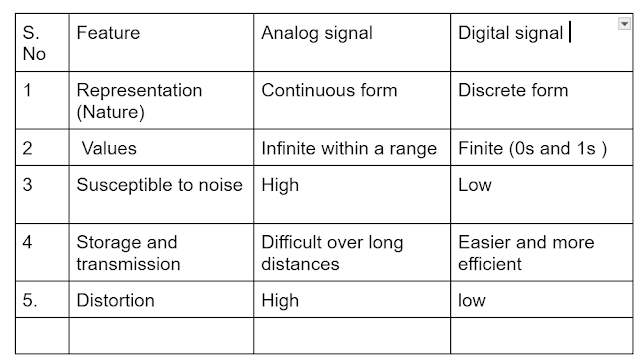
From the comparison of the two signals namely, digital and analog signals, we can understand clearly the ‘Advantages of Digital signals’ in modern digital electronics world. This is how the digital techniques are popular all over the world.
Applications
It is noteworthy to observe the various applications of these signals in the real world. Having studied the characteristics of both the signals, let us look at the applications and advantages of digital signals.
Analog signals – Analog signals are widely applied to
- Audio and video transmission
- Radio signals
- Temperature sensors
Digital signals
- Computer and smartphones
- Digital communication- wi-fi, Bluetooth
- Digital clocks
- Space technology
- And many more.
Conclusion
We have discussed in detail the ‘Advantages of Digital signals’ over Analog signals and appreciated how the digitals signals play an important role in the modern digital world.
You may appreciate it well that modern communications and control systems function smoothly using both the electronic signals. Specific applications need to use specific signals appropriate to the systems. Hence the right type of signals are employed for the right type of systems that are used to serve the purpose. In the modern world more and more applications are being used by digital systems.
As such we should keep our knowledge aptitude and skill well developed focusing on digital signals. From now on our attempts to popularise the digital techniques in all our future posts in our blog. Both Raju and Gopu felt that they have received sufficient and correct knowledge about the electronics signals, especially satisfied with the information discussed on digital signals.
We intend to discus binary systems of digital electronics in our next session. Hence please go through the post for up to date information on the subject.