


Introduction
We are discussing ‘Sequential Circuits’ in our tutorial on digital techniques. We have discussed flip-flops and then R-S flip-flops, their schematic, symbol and other parameters. We have exclusively studied R-S flip flop with illustrations as the first flop. Now we are going to discuss D Flip-Flop in detail, so that the readers can get a comprehensive information on the system and its functions.
In digital techniques, signal processing is the most important function for achieving the desired results. It’s also important to store the information for many purposes. Among the storing techniques, D Flip-Flop is one of the basic building blocks in digital electronics. As the storage process is simple and powerful, it is widely used in digital systems like computer memory, registers and counters. This functionality makes us to study in depth about D flip-flops.
Analogy of ON/OFF switch
In digital electronics, to store one bit of information, whether it is 0 or 1, a flip-flop circuit is used. In simple terms, you may consider an electrical light switch. By operating you may switch the light ON or OFF status. If you switch ON the light, the position of the switch stays ‘ON’ as it is until you switch it OFF again.
Similarly when you switch the light OFF, the status of OFF condition remains till the next action. Thus the switch remains in one position until you change it. The position status remembers and stays by the switch till it is changed. This flip-flop action is essential process for building memory in computers.
How does the D flip-flop work?
“D flip-flop”, it is significant to mention here that the letter ‘D’ stands for Data or Delay . The D flip-flop has two inputs and two outputs. Look at the symbol of the D flip-flop. The inputs and outputs are shown clearly.
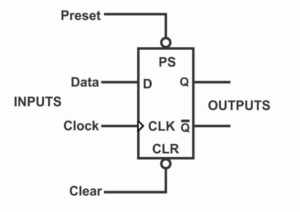
Inputs:
• D (Data) — The value you want to store (0 or 1)
• CLK (Clock) — A timing signal that controls when the flip-flop updates
Outputs:
• Q — The stored value
• Q’ (Q-bar) — The opposite of Q (if Q is 1, Q’ is 0)
It has also option to preset and clear, so that it can be preset when required and the action can be cleared once needed.
D Flip-Flop
Similar to R-S flip-flop and JK-Flip flop, D flip-flop too has two inputs and two outputs for its operation. The outputs determine whether it is going to store a binary 0 or a binary 1. The two inputs are D and CLK and work differently. The data or bit such as either binary 0 or 1 to be stored, is applied to the D input. The D flip-flop is controlled by the CLK input. CLK input is clock pulse which may be ‘high’ or ‘low ‘. The clock pulse input determines whether the input data at D is to be stored or not.
When the clock input at CLK is High, the data on the D line gets stored in the flip-flop. When the CLK line receives a Low, the D input line data has no effect and the bit stored previously is retained. No change in the status.
By elaborating the working principle of the D flip-flop, the input clock signal plays a major role for its operation. The clock is nothing but a timing pulse that dictates when to act. There are two important timing pulse types – Positive edge triggering pulse, Negative edge triggering pulse.
The positive edge is the rising edge of the clock pulse. The negative edge is falling edge of the clock pulse. So, at the time of rising edge clock pulse i.e when clock pulse moves from 0 to 1, arrives at the CLK input, the output changes. At the time of falling edge clock pulse i.e., clock pulse moves from 1 to 0, arrives at the CLK input, the output changes.
At the positive triggering instant, whatever the D input sensed 1 or 0 at that time, it gets stored. Even immediately the input at D changes, the output remains constant, until the CLK receives a next clock edge.
This performance is very important as it avoids unnecessary output changes and for effective synchronisation.
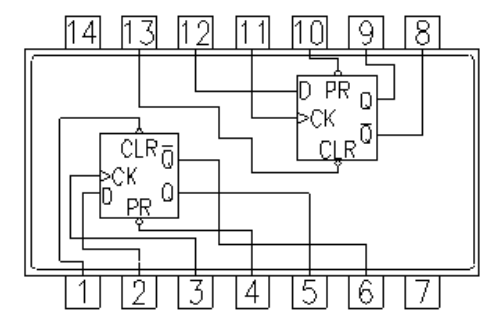
D flip-flop IC 7474
The 7474 IC is a popular TTL-series dual D-type positive edge-triggered D flip-flop with preset and clear inputs. The flip-flop IC contains two independent flip-flops in a single 14-pin package, primarily used for data storage, frequency division, and state machines. It operates at 5V and updates the output on the rising edge of a clock signal. Conventionally pin 14 is connected to positive power supply and pin 7 is grounded.
It has a D input and a Q output. The data in the D input may be changed during the high or low clock but it does not affect the output and the delay times also do not affect it. CLK is clock pulse input.
Truth Table of D flip-flop
Clock Edge D input Q Q'
Rising 0 0 1
Rising 1 1 0
No Edge X No change No change
The truth table of the D flip-flop is very simple and straight forward. This is possible only when the clock is active. When the clock is not active, the output does not change. Here ‘x’ means no clock edge, and hence do not bother about D input. There will not be any change in the output.
Application
Most of the digital systems like calculators, computers, digital clocks etc., use D flip-flop widely. By combining D flip-flops together in a group and use them, they can store more bit values. If eight such flip-flops put together in a group they hold eight bit storages each holding a 0 or a 1. Mainly D flip-flops are applied in ‘shift registers’, ‘frequency dividers’, and as synchronisation of data.
Why is the D flip-flop important in digital electronics? While other flip-flops like S-R flip-flop, JK flip-flop are in the confused and unpredictable state, D flip-flop has a clear, reliable and predictable functionality in digital electronics. Being simple and powerful, it stores one bit either 0 or 1.The advantage is commendable when combined innumerable of them to power anything up to supercomputers.
Read ‘sequential logic circuits‘ post , then you can understand the basics of the flip-flops working differently in digital electronics.
Conclusion
I fully hope that the study of significant logic function of the D flip-flop among other flip flips in the sequential circuits sharpen the knowledge and skill of an individual who pursue this tutorials on digital techniques. Logic functions, truth table and wide application of the D flip-flop are all explained in simple terms so that even a novice can gain interest in the digital techniques.




[…] on JK Flip-Flops. We have widely discussed earlier two flip-flops, namely the S-R flip-flop and the D flip-flop. Now we are in the study of the most important flip-flop-‘JK […]
[…] to measure the voltage at different points in the circuit.For this purpose, instruments such as a logic probe, a digital multimeter or even a simple DC voltmeter are used.These instruments help identify […]