


Introduction
Our next tutorial on the sequential circuit is an in-depth discussion on JK Flip-Flops. We have widely discussed earlier two flip-flops, namely the S-R flip-flop and the D flip-flop. Now we are in the study of the most important flip-flop-‘JK flip-flop’.
You know very well from the previous study of flip-flop, a flip-flop is a storage circuit in digital electronics that stores one bit of data either 0 or 1. Also we have studied that flip-flop has two inputs and two outputs. As such, JK flip-flop is also a memory circuit that can store one bit of data either 0 or 1. The output can be changed only by the control signal. Until it is ordered to change the switch remains in the remembered state.
Unlike SR flip-flop which becomes unstable when both S and R are 1, JK flip-flop overcome this problem by giving reserved input combination J=1 and K=1 makes the flip-flop toggle. Here the output simply flips from 0 to 1 or 1 to 0 every time the clock signal hits. Hence JK flip-flop is powerful and at the same time flexible because of the toggling feature.
This can be explained in simple terms as follows: A JK flip-flop has
Two main inputs J and K
A clock input CLK
Two outputs Q and Q-dash
J is like ‘set’, when J=1 and K=0, the flip-flop sets Q to 1. K is ‘Reset’ When J=0, and K=1, it resets Q to 0. When both the inputs are 0, the flip-flop holds its previous value and no change is observed. When both the inputs are 1, then the flip-flop toggles, Q becomes Q-dash. Please note that these changes are occurred only when the rising or falling edge of the clock signal. AS such it is called edge-triggered operation and the circuit stability is confirmed.
Symbol of JK flip-flop
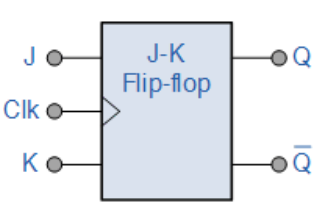
From the foregoing symbol of JK flip-flop, it is clear that J and K are the two inputs as shown in figure. Apart from this, the clock pulse also given to the flip-flop as marked Clk. The flip-flop has two outputs Q and Q dash. Remember in digital electronics circuits, the flip-flop is being shown by the symbol as shown above. Hence it is necessary to familiarise with the symbol so that one can identify and understand how the JK flip-flop is being used in the digital electronics circuits.
Why JK flip-flop is needed
Actually SR flip-flop has a slight drawback in its functionality. When two inputs of the same binary number namely S=1and R=1 are given to SR flip-flop, the output becomes invalid or undefined. This wrong functionality is overcome in the JK flip-flop, thereby solving the issue. As such we can say, this flip-flop is an improved version of the SR flip-flop.
How JK flip-flop works
The JK flip-flop works on the combination of J and K inputs, that too only when the clock pulse is active.
The output varies only during clock transition i.e. rising and falling edge.
If J=0 and K=0, then no change ( memory state)
If J=0 and K=1, then Reset (Q=0)
If J=1 and K=0, then Set (Q=1)
If J=1 and K=1, then Toggle (Q switches state)
Truth table of JK flip-flop
| J | K | Clock | Next Output Q |
|---|---|---|---|
| 0 | 0 | No change | |
| 0 | 1 | 0 | |
| 1 | 0 | 1 | |
| 1 | 1 | Toggle |
Race around condition
When two inputs J=1 and K=1 are given and the clock pulse is also High for long duration, one drawback occurs in the JK flip-flop. The resulting output keeps toggling very rapidly like 0- 1-0-1-0-1 -….. This drawback is called Race Around Condition. The output becomes unstable and the final stage is unpredictable. To solve this race around condition, Master-Slave JK flip-flop was developed.
What is Master-Slave JK flip-flop?
JK flip-flop uses two flip-flops namely Master and slave.
Master flip-flop captures input, whereas
Slave flip-flop produces output.
Working: Master flip-flop works when the clock is HIGH
Slave flip-flops works when the clock is LOW.
IC7476 JK Flip-Flop
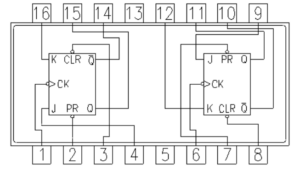
The 7476 IC has two J-K flip-flops with set and reset that you can use individually. The JK flip-flop can be set, reset, and toggled. It can be used for making counters, event detectors, frequency dividers, and much more. We will experiment the functionality of this flip-flop in our experimental section namely ‘Practicals’ in detail.
Uses
JK flip-flops are used in
Counters – used in binary counters
Registers – store binary data and used in CPUs and memory units
Frequency division-toggle mode divides clock frequency
Shift registers-data shifting operations.
Though the flip-flop has some limitations like ‘race around condition and slightly more complex than SR flip-flop, its advantages are many. First of all there is ‘no invalid state’. Besides it has versatile operation. It can perform like SR, D or T flip-flop
Conclusion
In digital electronics JK flip-flop has secured most important place in sequential logic devices. The important aspect is it overcomes the drawbacks of SR flip-flop. As such it initiates a powerful toggle feature. The Master-Slave configuration makes the JK flip-flop a reliable component in digital electronics. It helps in designing counters, registers or control systems in the day to day digital electronics.