


Introduction
First and foremost, ‘XOR and XNOR Gates’ symbols are given for familiarisation and clarity.
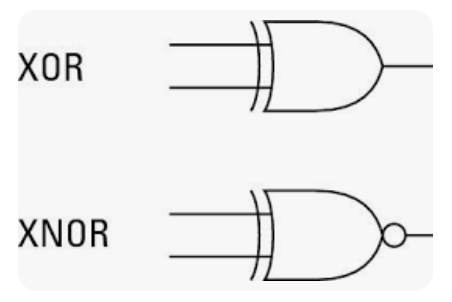
We now dive into studying exclusive logic gates, namely ‘X-OR and X-NOR Gates’ in this post. The truth table for an OR gate shows that the output of the gate is binary 1 when any input is 1. The output is also 1 when both inputs are 1. The latter combination of inputs is not acceptable for many applications where an exclusive OR function is required.
As such an exclusive-OR gate fulfills the required functionality when it is warranted in many application circuits. Hence we study here the exclusive-OR gate set up, logic functions etc. in this post. Not only that we are going to study yet another logic gate , say exclusive-NOR as its function is just opposite to exclusive-OR.
The schematic symbol and truth table for an exclusive-OR gate are shown in fig. below. Exclusive-OR, also known as X-OR, is also exclusive-NOR for X-NOR. These gates are used in applications like adders, parity checkers, etc., which we are going to discuss in detail.
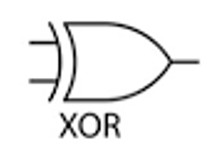
Symbol of the X-OR gate
Among the ‘XOR and XNOR Gates’, we study first X-OR Gate. The symbol for XOR gate is given below.
Truth table
We will go through the truth tables of both ‘XOR and XNOR Gates’ individually, so that the logic functions can be clearly understood by any one.
First, we go through the truth table of the X-OR gate, and then we can understand the gate logic function and its role in digital electronics.
X-OR Truth Table
| A | B | Q |
|---|---|---|
| 0 | 0 | 0 |
| 0 | 1 | 1 |
| 1 | 0 | 1 |
| 1 | 1 | 0 |
From the truth table, we can easily identify the function of the gate. Observe the input and output parameters to ascertain the logic function.
Observation
If both inputs A and B are the same, i.e. A=0 and B=0, or A=1, B=1, then the logic gate X-OR gives a LOW output, namely 0. As such, if both the inputs A and B are different, i.e. A=1, B=0 or A=0, B=1, then the X-OR output is HIGH, namely 1. That is why it is called an Exclusive-OR gate, because it selects one input exclusively when they differ.
Observation from the truth table:
The output is 1 only when the inputs are different
The output is 0 when the inputs are the same.
‘Exclusive’ OR Why is it so called?
The output of OR gate 1 when any one or both inputs are 1
But in x-OR gate, the output is 1 only when either A or B is 1, but not both. x-OR gate excludes the condition when both inputs are 1. Hence it is exclusive-OR gate.
The Boolean expression is Y=A+B / Y=A’B+AB’
Actually, an X-OR gate can be built from fundamental logic gates. As such, it is not a basic gate. To build an X-OR gate, we require 2 NOT gates, 2 AND gates and 1 OR gate. The ‘X-OR and X-NOR gates’ are complementary logic gates that play a fundamental role in digital electronics. XOR acts as a difference detector.
You can exclusively distinguish between the OR gate and the XOR gate by reading the tutorial on the OR Gate.
Out of ‘X-OR and X-NOR gates’, we have concluded the study of X-OR gate.
Exclusive-NOR (X-NOR) Gate
Among the ‘XOR and XNOR Gates’, secondly, we intend to study X-NOR gate here.
As we know that the logic gates are the building blocks of computers, calculators, communication systems, etc., the exclusive-NOR (X-NOR) gate plays a vital role in digital comparison and equality detection. These functions are necessary for the digital equipment to function as required.
The exclusive-NOR circuit for which the symbol and the truth table are shown below. Let us study the truth table from which we can arrive at the functionality of the gate.
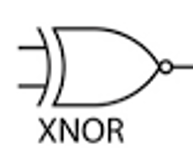
Logic symbol of X-NOR gate
The logic symbol for the X-NOR gate is given below.
Truth table
The truth clearly reveals the logic function of the X-NOR gate.
X-NOR Truth Table
| A | B | Q |
|---|---|---|
| 0 | 0 | 1 |
| 0 | 1 | 0 |
| 1 | 0 | 0 |
| 1 | 1 | 1 |
From the truth table, we can define the X-NOR Gate.
The X-NOR (Exclusive-NOR) gate is a digital logic gate that gives a HIGH (1) output only when both inputs are the same. ( Please compare here the logic function of the X-OR gate).
Simple Rule:
The output is HIGH, i.e. 1, when the inputs are equal
The output is LOW, i.e. 0, when the inputs are different
This is why the X-NOR gate is called the equivalence gate.
We can clarify this with the help of the truth table given above. If both inputs A and B are the same, i.e. A=0 and B=0, or A=1, B=1, then the logic gate X-NOR gives a HIGH output, namely 1. As such, if both the inputs A and B are different, i.e. A=1, B=0 or A=0, B=1, then the X-NOR output is LOW, namely 0. That is why it is called an Exclusive-NOR gate, because it selects both inputs exclusively when they are equal.
Observation from the truth table:
The output is 1 only when the inputs are equal
The output is 0 when the inputs are different.
Thus, the XNOR gate acts as a digital equality detector.
It excludes the unequal cases and allows only equal cases.
The Boolean expression is Y = AB + A’B’
Understand the difference between the NOR Gate and the XNOR gate by reading the NOR Gate tutorial.
By this we have studied the ‘XOR and XNOR Gates’ in depth making use of symbols and truth tables.
Conclusion
In digital electronics, both the ‘X-OR and X-NOR gates’ play complementary roles in logic gate operations.
X-OR acts as a difference detector
X-NOR acts as an equality detector
This is an important function they offer in a reciprocal way. Their outputs are always opposite to each other. A better understanding of the comparison between these two gates is essential for designing:
Adders, Subtractors, Digital comparators, Parity checkers, Communication systems, etc.
No doubt mastering ‘X-OR and X-NOR gates’ strengthens your foundation in digital logic design and prepares you for advanced circuit development.




[…] XOR (Exclusive-OR) Gate Logic Function is proved by conducting this experiment. As our 6th experiment, we practically do the experiment with the XOR gate circuit to prove its logic function, so that a reader can get enhanced knowledge and skill in understanding the logic function thoroughly. This experiment is a promotional aspect for the theory tutorial on the XOR gate logic function. […]